 Nigerian Democracy is tortuous, And Crookish- Gov. FayemiBy Moses GbandeThe Chairman Nigerian Governors’ Forum and the Governor of Ekiti State, Dr. John Kayode Fayemi has discribed the 20 years of democratic rule in Nigeria as a tortuous one.Dr. John Kayode Fayemi who confidently expressed his feelings in Jos while addressing members of the Executive Course 41 of the National Institute for Policy and strategic Studies, (NIPSS)-Kuru says right from the incursion of the Military into the political space in 1966, when the fragile democratic structures of the country were literally pulled down, the journey for democracy and democra tisation has been with sweat and blood.Speaking on the topic, “Twenty years of Democratisation in Nigeria: Looking backward, moving forward, Dr. Fayemi maintained that, “Quite ironic was the fact that while Nigerian Leaders that fought for the independence of Nigeria did not have to die in the hands of the colonial authorities, many Nigerians were illegally incarcerated, maimed, dehumanised and killed by their own millitary before we could get democracy.”I do not need to repeat without sounding horing, the fact that many notable pro-democracy personalities were murdeted in cold blood because of the fight for the instruction of democracy in Nigeria”.He said the system deteriorated from all sectors of life including electoral management, manipulation of the press, multiple party system with bad legal system to manage the democratic system.”The Supremacy of the law means that all persons and institutions governed by law are equally subjected to the law. More succinctly‚ it means that even agents of state are submissive to the dictates of the law, for, this is the only guarantee that people‘s right are protected from any dictatorial tendencies.”It is the guarantee that private businesses owned by foreign nationals can be protected from severe adversity of diplomatic hostilities among nations. It also provides guarantee that ordinary citizens can have a place to ask for relief if their rights and privilege are trampled upon.”One could confidently say that the rule of law has taken roots in Nigeria.We have seen many instances that the federal government have lost cases to states, individuals and institutions. In fact, there are many judgement debts hanging on the police and other security agencies as result of court pronouncements.”We have seen courts reinstating people who got their appointments terminated under malicious circumstances. The courts have intervened in so many classical cases that have strengthened our constitutional jurisprudence on many matters that touched on the constitution, federalism, resource distribution and many others.”As a governor in Ekiti, I have got many unfavourable judgments from the state high courts; although some see this as strange in the states but this is a common experience in Ekiti. We can only wish for the better, there is no doubt that the rule ot law and the protection of human right is getting rooted in the Democratic practice ot Nigeria and this is without prejudice with the fact that we still have concerns about the integrity of some of the juries and the quality of their ptonouncements. But these are exceptions than the norms.”Before coming to the political space, my first forth was in the civill society oxganisation. I cofounded the Centre for Democracy and Development (COD) which was dedicated to the promotion of democratic ideas, good government and the democratisation of the country. I have been involved in many ptogrammes aimed at engendering democratic practice after the long years of military mindset to pubkic governance.
 “It is therefore comforting to witness that Nigeria has very vibrant civil society organisations that have been in the vanguard of policy, advocay, public engagements m and capacity development programmes. They have also served as a formidable bastion of policy analysis and public enlightenment.”In oome cases, they have mobilised the public in resisting what they considered as & threat to public interest through protests‚ litigation and advocacy.”While we can pat ourselves at the back for the modest successes we have achieved, we do not need to be told that the job remains unfinished. I have indicated before, there is no ready-made democracy, every democratic nation continues to improve on how to be better in serving the greater number of the people.”However, I should like to highlight some areas that urgently needs radical improvement for us to further deepen our democratic culture, this is because until our democratisation process becomes an everyday culture, it would continue to be met with a dissonant disposition among the people generally.”Essentially‚ Nigeria is still a traditional society where some elements of feudal, monarchical and theocratic practice deeply influence the values and social relations among her peoples, this has made the concept of citizenship a lot difficult to fully have its meaning.”This has unfortunately, ultimately done an incalculable dent on our democratisation process and in fact, fed most of what are known as communal and ethnic conflicts in the country. Our democratic culture is still waved around primordial clannish boundaries such that people can only contest election in a place called their “state of origin”.”Nigerians must boldly interrogate the definition of a people as “non indigene” settlers or even strangers in a country they call their own!”Democracy make more meaning when citizen has the same rights and privileges no matter where they live it settle.”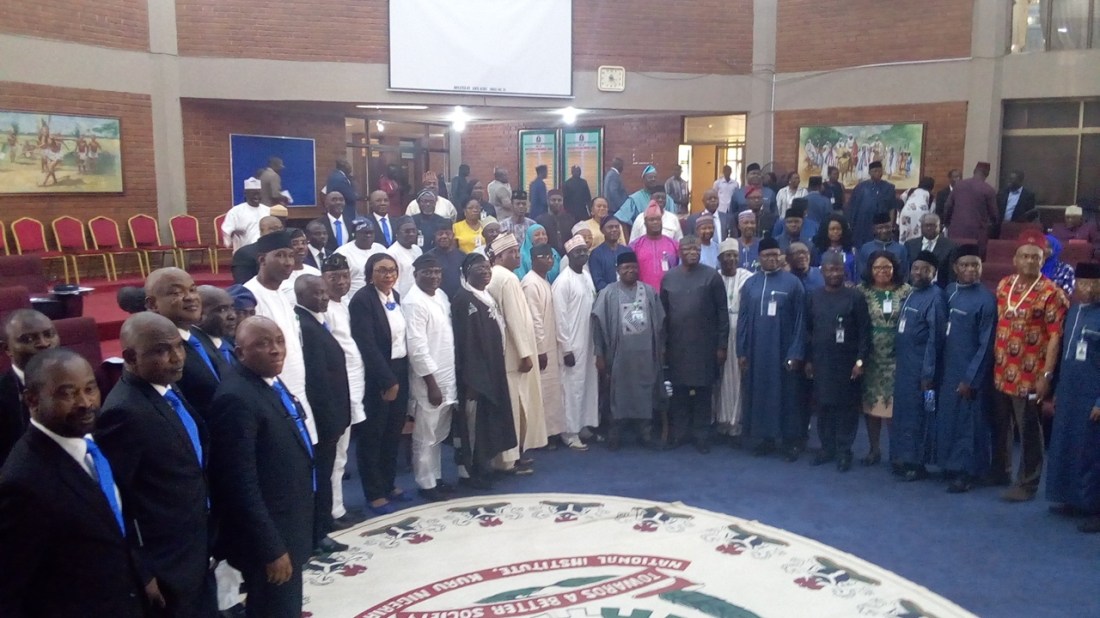
Nigerian Democracy is tortuous, And Crookish- Gov. Fayemi

Published
 Nasarawa Reporters